
TEACHING at NYU, Harvard, and beyond
Since Fall 2026, I’ve been teaching in the Department of Social and Cultural Analysis at New York University, where my courses bring global and transnational approaches to U.S. history into conversation with migration and border studies, religion and American cultural politics, histories of U.S. empire and the Pacific, and Asian/Pacific/American Studies. Across my teaching, I examine how migration, race, religion, empire, and citizenship have shaped the United States and its relationships with the wider world. I am particularly interested in helping students move between large historical structures—law, state power, colonialism, racial formation, and political economy—and the everyday worlds in which those structures are experienced, negotiated, and contested.
My teaching is guided by the principle that interpretive freedom grows from firm grounding. I introduce students to a shared vocabulary of key concepts and methods, then ask them to test those frameworks against historical evidence, cultural texts, and lived experience. Assignments are scaffolded from close reading and document analysis toward increasingly independent work with archives, newspapers, immigration records, oral histories, literature, and visual and material culture. Whenever possible, students translate their research beyond the conventional paper through public-facing forms such as exhibits, zines, podcasts, or other creative projects. The goal is to combine methodological precision with multiple points of entry, giving students the tools and confidence to develop arguments of their own.
Across NYU, Harvard, and public humanities settings, I have taught at multiple levels and in varied formats: undergraduate lectures and seminars in U.S. history, American diversity, and Asian American and Pacific Islander Studies; graduate courses in U.S. religious history and transnational socio-cultural changes; a graduate pedagogy practicum; and a community-based course on the Korean diaspora. At Harvard, my teaching was recognized by Harvard College with the Certificate of Distinction and Excellence in Teaching in 2021 and 2022.
A detailed teaching philosophy statement and teaching portfolio, including numerical and narrative student evaluations, are available upon request.
NEW YORK UNIVERSITY
SCA-UA 380: Cross-ing America: Religion, Race, and Immigration in U.S. History (Instructor, F26)
Synopsis: What role has religion played in shaping who can move, belong, and become American? This course examines how the United States has been structured through overlapping histories of im/migration—including settler expansion, forced displacement, slavery, imperial mobility, and immigration—and how religion has been central to organizing these movements and their meanings. The course treats religion not as private belief alone, but as a structuring force in law, governance, racial formation, and everyday life. Topics include Indigenous dispossession and the transatlantic slave trade; Asian exclusion and European restriction; immigrant religious worlds in urban America; the Great Migration; Cold War refugees; the securitization of Muslim migration after 9/11; and contemporary debates over asylum and the U.S. border. At the same time, the course considers how migrants and minoritized communities have drawn on religion to contest exclusion, sustain collective life, and remake social and political worlds. By tracing how groups once cast as outsiders have been incorporated on unequal terms through shifting boundaries of belonging, students will develop the historical and theoretical grounding—and the ethical sensitivity—needed to navigate today’s most pressing debates over immigration, citizenship, and the politics of belonging.
New York University
Department of Social and Cultural Analysis, College of Arts & Science
Format: Lecture (capped at 30)
SCA-UA 380: Topics in A/P/A Studies: The Politics of Paradise (Instructor, F26)
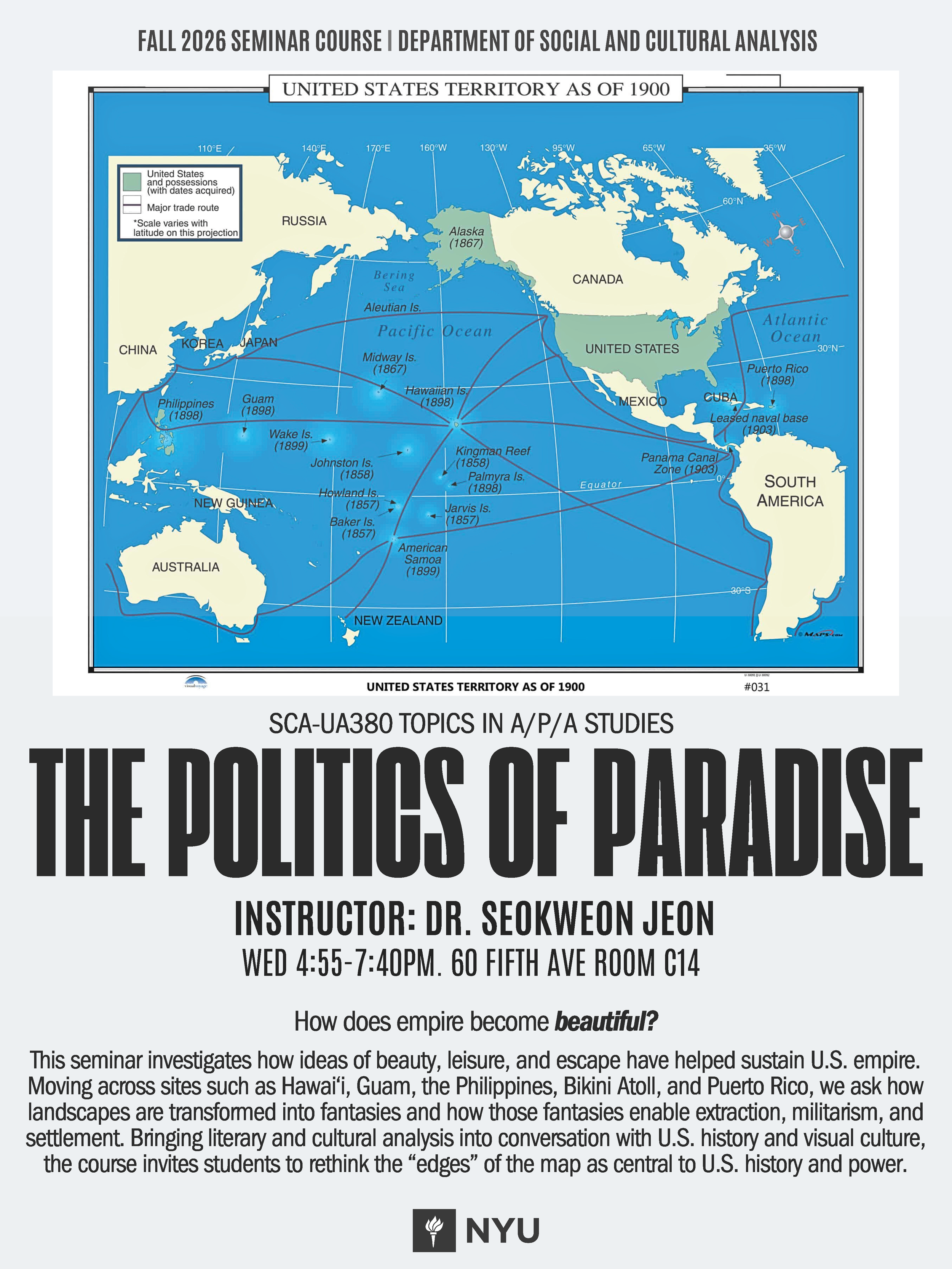
Synopsis: What does it mean when the site of an American nuclear test becomes a swimsuit brand? This seminar examines "paradise" as a political and cultural formation—a way of seeing that has naturalized American sovereignty, enabled extraction, and rendered distant places and their peoples available for American desire and control. From Hawai'i and Guam to the Philippines, Okinawa, Vietnam War-era Rest & Recuperation (R&R) circuits, Bikini Atoll, and Puerto Rico, we trace how Asian and Pacific spaces have been imagined as beautiful, timeless, and open—for leisure, militarism, and settlement—even as they remain sites of occupation, struggle, and resistance. Drawing on Pacific studies, Asian American literature, and US political and cultural history, students learn to read empire not only in its military and legal architecture but in its dreams—the desires and fantasies through which power sustains itself. The course centers Indigenous and local voices who refuse and reimagine the frame. Through intensive discussion, a museum visit, and an original research or creative project, students will see that the so-called “edges” of the map are in fact central to the making and remaking of the United States.
New York University
Department of Social and Cultural Analysis, College of Arts & Science
Format: Seminar (capped at 20)
HARVARD UNIVERSITY
HDS 2185: Narratives of American Religion: The Canon and Its Revisions (Teaching Fellow, F21 & S25)
Synopsis: What is the American religious historical “canon”? What stories have historians chosen to tell about America’s religious past? How has the canon been revised in recent decades as historians have challenged older understandings of who “makes” history?
This course examines narratives of American religious history from the nineteenth century until the present. Beginning with Robert Baird's Religion in America (1844), and concluding with Jon Butler, Grant Wacker and Randall Balmer’s Religion in American Life (2003), we will trace how scholars have imagined the whole "plot" of American religious history. We will focus particularly on how narratives have changed over time.
Harvard Divinity School Course (level: graduate)
Course Heads: Catherine Brekus and David Holland
HDS 2343: Christianity at the Crossroads: the Global Church from the Print Revolution to the Digital Era (Teaching Fellow, S25)
Synopsis: Much of the writing on the history of Christianity is organized around national histories and religious denominations or traditions. By contrast, this course aims to build on work by historians of all kinds, not just historians of religion, suggesting that traditional explanations of religious, social, and cultural change have undervalued the role of international networks and transnational encounters in shaping the dynamics of religious change and innovation. By looking at a selection of such international networks, and nodes and nuclei (or junction boxes) as sites of encounter among different traditions and cultures, the course will analyze patterns of change and transmission that will challenge conventional historiographies and modes of explanation. The course concentrates predominantly on the period 1500-2000 and will include international religious networks such as the Catholic religious orders (Jesuits), Protestant benevolent and missionary societies, migratory populations resulting from colonialism and other factors, the rise of transnational Pentecostalism, print networks, and so on.
Harvard Divinity School Course (level: graduate)
Course Head: David N. Hempton
EMR 1020: Topics in Asian American and Pacific Islander (AAPI) Studies (Teaching Fellow, S22 & S23)
Synopsis: This course looks to historical, theoretical, and cultural sources to understand Asian American and Pacific Islander visions for identity, justice, community, and coalition. We will consider in each case the complexities involved in navigating coloniality, racial formation, and particular temporal and local contexts. This course foregrounds issues of coloniality and ecology, anticolonial and antiracist solidarities, and formations of desire/ability.
Harvard College course (level: undergraduate)
Course Head: Eleanor Craig
REL 3004: Pedagogy in the Study of Religion (Course Organizer & Facilitator, S23)
Synopsis: This course is designed for PhD students in the Committee on the Study of Religion, and is open to students in related fields who teach courses pertaining to religion. The course aims to equip students with skills to be effective Teaching Fellows at Harvard and to develop their own approaches to pedagogy as independent instructors in the field of religion. Classes will be workshop-style and will cover various teaching methods, course design, and professional development topics. They will also provide a space to discuss day-to-day success stories and challenges in the classroom.
Harvard Graduate School of Arts and Sciences (level: graduate)
HDS 2187/REL 1497: Evangelicalism in America (Teaching Fellow, F22)
Synopsis: This course is an overview of American evangelicalism from the 1740s to the present. Beginning with the rise of transatlantic evangelicalism in the eighteenth century, we will explore the growing power of evangelicals after the American Revolution, the crisis caused by slavery, the Fundamentalist-Modernist controversy in the early twentieth century, the emergence of Pentecostalism, the controversies created by neo-evangelicalism in the 1940s, the Civil Rights Movement, the charismatic movement, and evangelicalism today. Throughout the course, we will focus on the historical development of evangelicalism and the relationship between evangelicals and American culture, with special attention to gender, race, and nationalism.
Harvard Divinity School Course (level: graduate)
Course Head: Catherine Brekus
GenED 1166: Pluralism: Case Studies in American Diversity (Teaching Fellow, F21)
Synopsis: Who do we mean when we say “we?” How does our society deal with religious, ethical, and cultural diversity? What challenges do we face as people of different communities encounter one another in cities and public institutions, schools and businesses, neighborhoods and families? This course explores, discusses, and analyzes the changing multi-cultural and multi-religious landscape of America with an eye to the growing Muslim, Buddhist, Hindu, and Sikh communities in the most recent period of post-1965 immigration. The course’s approach is through the study and in-class discussion of case-studies enabling you to enter into some of the controversies and dilemmas that confront us in our schools, universities, town councils, zoning boards, and places of work.
Harvard College General Education course (level: undergraduate)
Course Head: Diana Eck
PUBLIC-FACING TEACHING
BNI F23: Invention of the Family: Religious History of the Korean Diaspora (Instructor, F23)

Synopsis: Designed for Korean/American communities, religious leaders, and general publics, this course traces the religious formation of the Korean diaspora in the United States, examining how Protestant Christianity generated new modes of racial, moral, and communal belonging under pressures of exclusion, empire, and displacement.
From early twentieth-century mission-linked migrations to Cold War evangelicalism and transnational adoption, we explore how Korean diasporic subjects were not merely received but assembled—molded into coherence through Christian institutions, theologies, and moral vocabularies. Rather than treating religion as mere background, we analyze it as a historical force that rendered Koreans intelligible to the American racial state as exceptional migrants, model believers, and ideal citizens.
Home Institution: Boston Nehemiah Institute (BNI)
Level: Public-facing course