first Book Project
Sacred Borders, Divine Hierarchies:
American Liberal Protestants, US Immigration Policymaking,
and The Un/making of the Asian Exclusion Era, 1875-1924

(Photo Credit: “A Statue for Our Harbor.”
George Frederick Keller for The Wasp. Nov. 11, 1881. Historical Society of Pennsylvania)
Sacred Borders, Divine Hierarchies offers a religious and discursive history of the modern American immigration state. Rather than treating the rise of federal immigration restriction in the United States at the turn of 20th century as a story primarily of labor conflict, racial nativism, legal development, or bureaucratic expansion, the book asks how exclusion became morally intelligible and emotionally durable. It argues that liberal Protestantism—the culturally dominant religious formation of the late nineteenth and early twentieth centuries—did not merely comment on immigration politics from the outside. It helped build the moral, institutional, and affective infrastructure through which Asian exclusion became thinkable, administrable, and defensible as an act of national stewardship rather than coercion.
The book traces this religious and cultural architecture of exclusion from the Page Act of 1875 to the Johnson-Reed Act of 1924. Moving across China, India, California, Boston, Washington, D.C., and the broader Pacific world, it follows missionaries, reformers, rescue-home workers, denominational leaders, social scientists, restrictionist organizations, immigration officials, and Asian/American Christian critics. I show how Protestant institutions helped create practices of surveillance, certification, rescue, and classification that the federal state later absorbed and formalized. I also show how missionary writing, sermons, philanthropic surveys, and reform literature produced a body of “moral knowledge” about Asian sexuality, character, domesticity, religion, and assimilability—knowledge that gradually hardened into the evidentiary grammar of admission and exclusion.
At the center of the book is what I call the progressive-exclusionary paradox: the fact that some of the most reform-minded, internationally engaged, and theologically sophisticated Protestants—not only crude nativists or reactionary exclusionists—supplied Asian exclusion with its most durable moral legitimacy. The same liberal Protestant commitments that animated missions, abolitionist memory, the Social Gospel, women’s protection work, and social reform also helped translate hierarchy into duty, exclusion into care, and racial restriction into Christian responsibility. The book therefore challenges the familiar binary in which religious and/or cultural progressives appear as natural allies of immigrants and religious conservatives as the primary agents of xenophobia. It shows instead that liberal Christianity itself was deeply implicated in the making of the exclusionary state.
This argument also revises how we understand the remaking of American Protestantism itself. Histories of the emerging liberal-conservative divide have most often centered on controversies over biblical criticism, evolutionary science, theological modernism, social reform, and changing forms of religious authority. Sacred Borders, Divine Hierarchies identifies immigration and citizenship as another consequential but comparatively understudied arena in which those divisions were articulated and sharpened. Debates over Asian migration were especially revealing because they brought questions of racial difference, religious pluralism, Christian universalism, national sovereignty, and the limits of assimilation into unusually close relation.
The resulting divisions did not map neatly onto a simple opposition between liberal inclusion and conservative restriction. Liberal Protestants could invoke Christian universalism, internationalism, humanitarian reform, and the promise of assimilation while simultaneously constructing hierarchies of civilization and moral fitness that legitimized differential admission and exclusion. Immigration therefore appears in this book not merely as an issue upon which already-formed liberal and conservative camps disagreed, but as one of the arenas through which competing visions of modern Christianity, national belonging, and Protestant political responsibility were themselves being worked out.
The book likewise repositions Asian exclusion within the larger history of American immigration and border governance. Rather than treating anti-Asian restriction as a regional western episode or an ethnic exception to the main story of immigration history, the book argues that debates over Chinese, Japanese, Korean, and South Asian mobility were central sites where the United States learned to moralize border control. In these debates, questions of race, religion, labor, sexuality, empire, and state power converged with unusual force. Asian exclusion became one of the key arenas in which Americans defined who could be civilized, who could be Christianized, who could be assimilated, and who could belong.
The book also recovers Asian and Asian American Protestant voices who challenged this architecture from within. Chinese and Japanese Christian leaders, missionaries, students, journalists, and reformers mobilized the language of scripture, Christian universalism, and American ideals to expose the contradictions of a nation that preached liberty, justice, equality, and salvation abroad while building racial barriers at home. Their critiques reveal that Protestant discourse was never a single chorus of exclusion. It was also a contested arena in which Asian/American Christians demanded recognition not as objects of rescue or conversion, but as fellow believers, moral interpreters, and critics of Christian America.
Ultimately, Sacred Borders, Divine Hierarchies argues that U.S. immigration policy has never simply been a bureaucratic or legislative mechanism. Rather, immigration control is profoundly moral and cultural, continually defined and redefined through contested religious imaginaries, racial anxieties, and cultural narratives. By historicizing these moral struggles, my dissertation provides crucial insight into why America’s borders remain morally charged, culturally fraught, and perpetually re-contested through struggles over race, religion, and belonging.
*The book is based on my dissertation (Harvard University, 2026), advised by Catherine Brekus (chair), David F. Holland, and Erika Lee.
-
![]()
Missionary Map of the World
August R. Ohman, Missionary Map of the World Showing Prevailing Religions of Its Various Nations and the Central Stations of All Protestant Missionary Societies (New York: August R. Ohman, [1902?]), map, Library of Congress Geography and Map Division, https://hdl.loc.gov/loc.gmd/g3201e.ct004005.
-
![]()
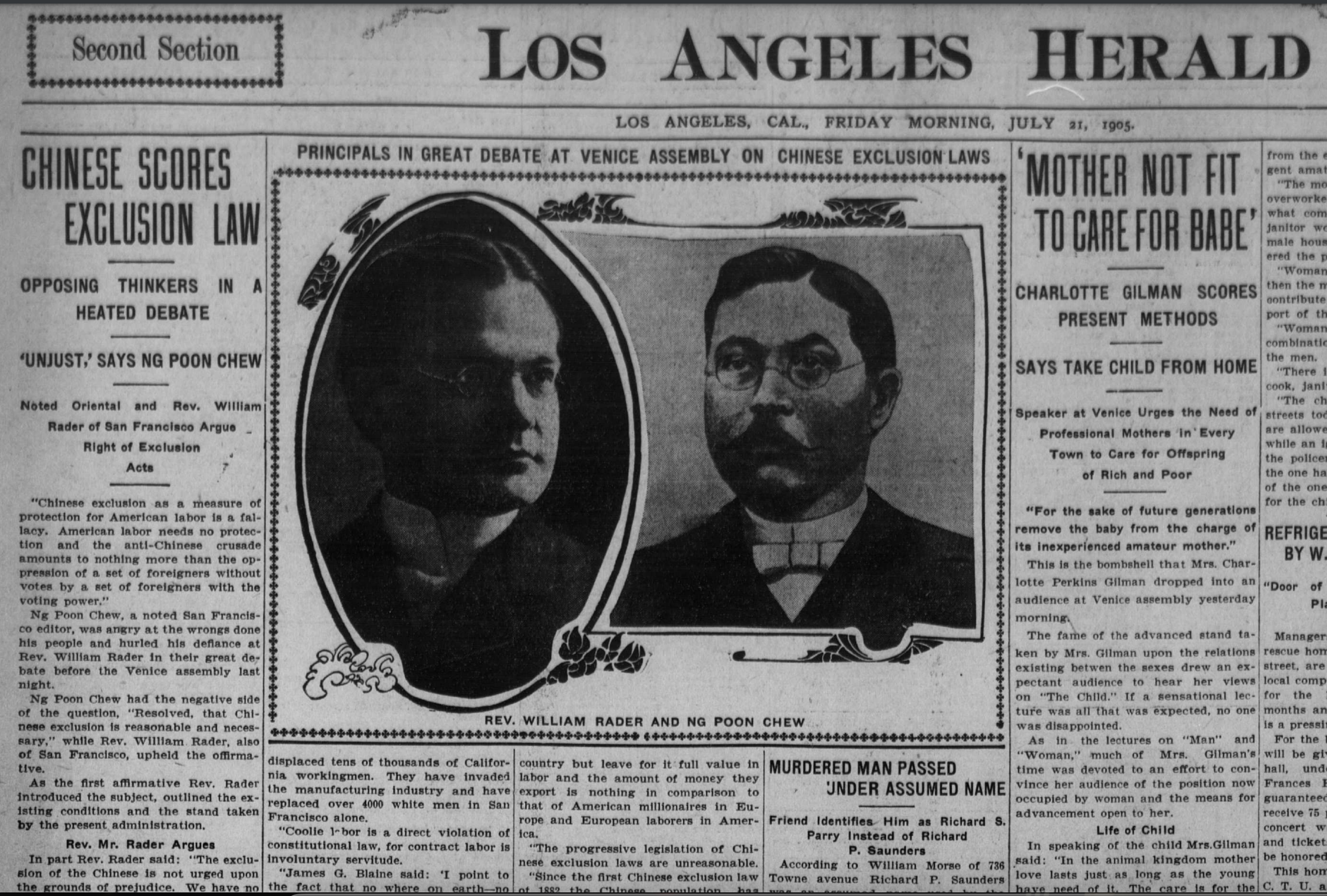
Rev. William Rader served as a key speaker for the exclusion of Chinese.
Los Angeles Herald. July 21, 1905. / University of California, Riverside; Riverside, CA
-
![]()
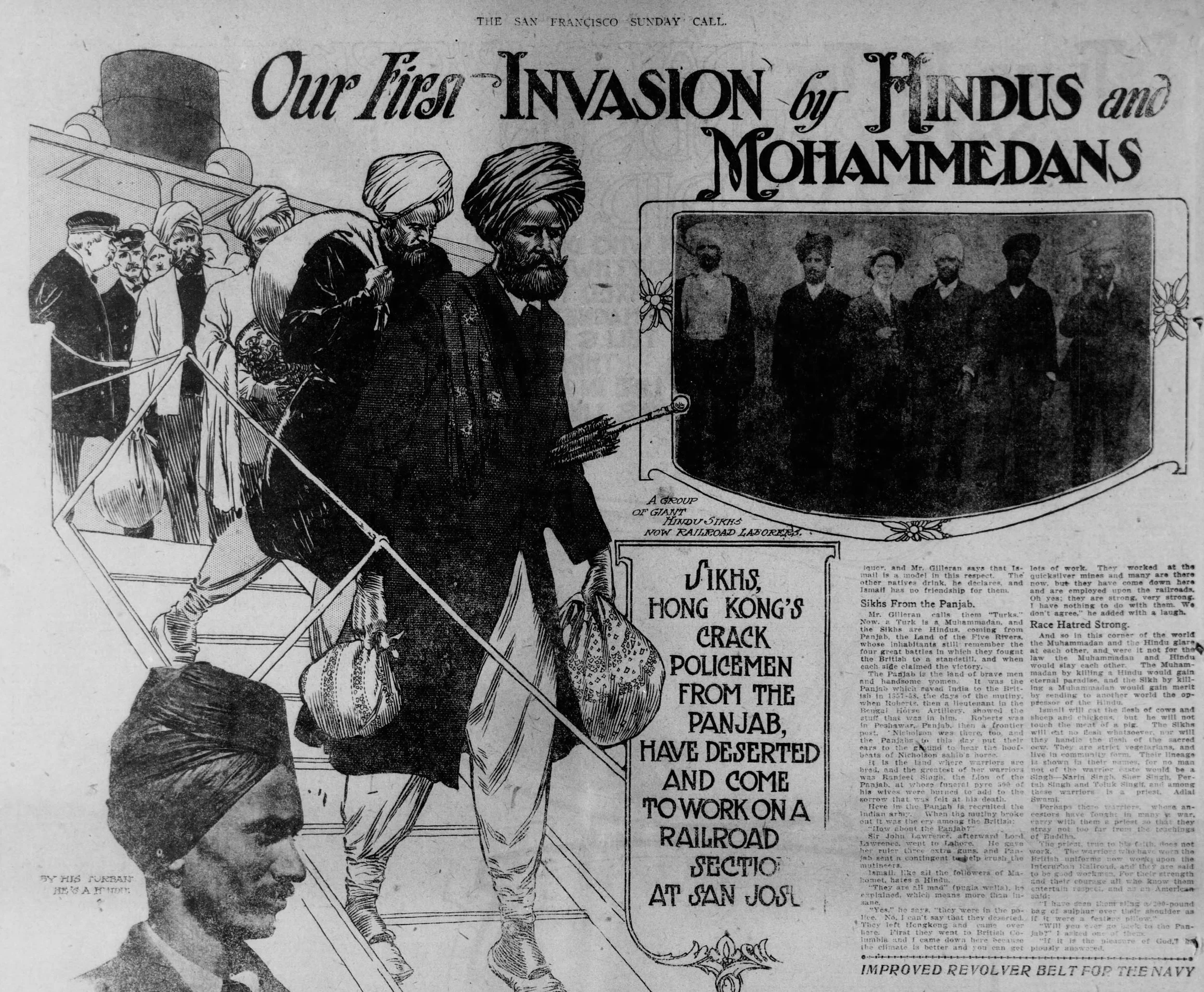
"Our First Invasion by Hindus and Mohammedans"
In 1910, widespread hysteria over South Asian migration, fueled by political and cultural leaders, labor unions, and amplified by mainstream media, was pervasive. National and local presses alike echoed alarmist religious rhetoric, referring to the so-called "tide of turbans" or "Hindoo(u) Invasion." An early example of this can be found in an article by John Hamilton Gilmour titled "Our First Invasion by Hindus and Mohammedans," published in the San Francisco Sunday Call on November 18, 1906.
-
![]()
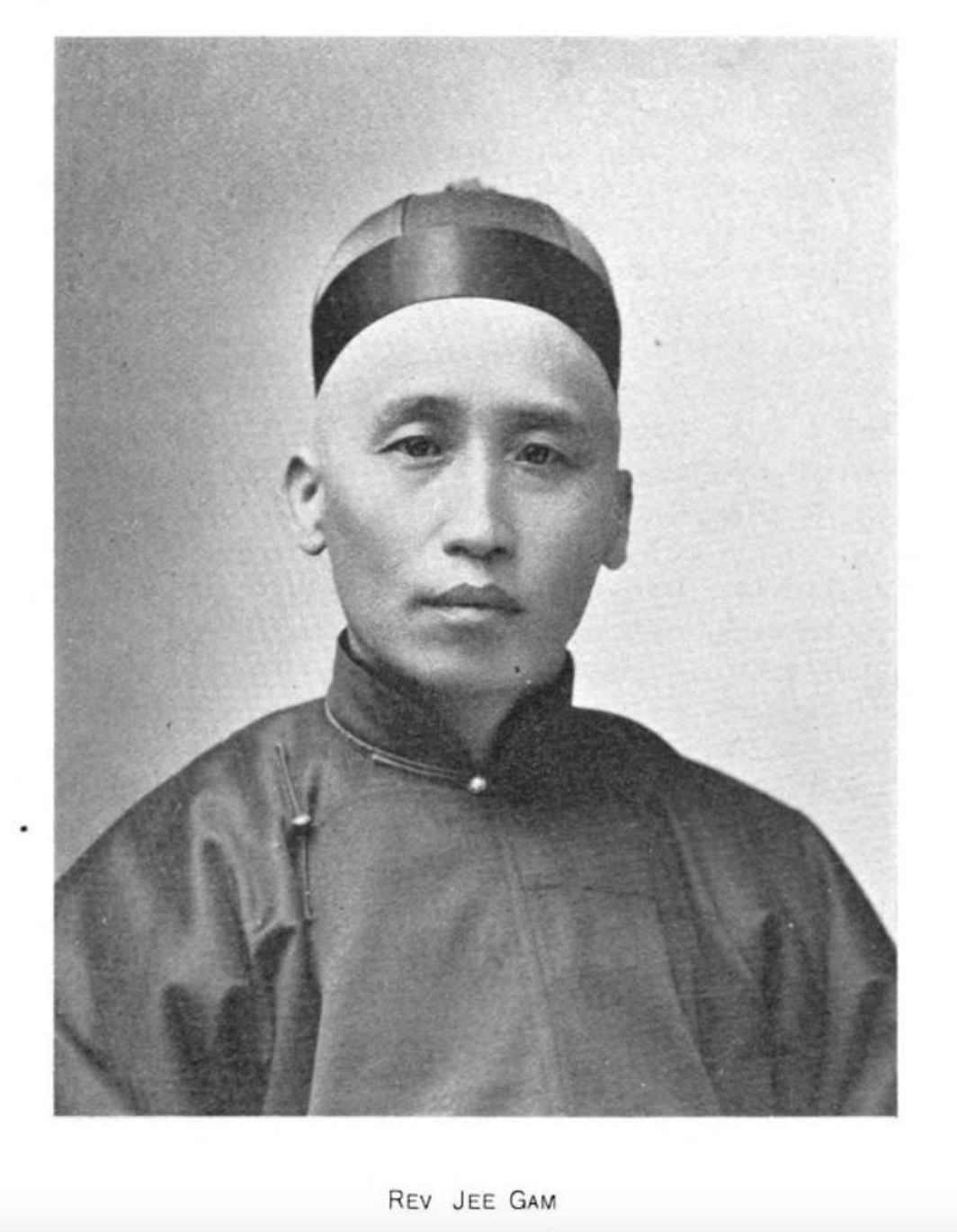
Jee Gam, Reverend, Rebel, Rhetorician
Jee Gam was the first Chinese American ordained as a Congregationalist minister in 1885. Despite facing the systemic denial of U.S. citizenship, he devoted 25 years to serving the church, emerging as a vocal advocate for racial equality and the enfranchisement of Chinese Americans.
At the height of the growing tide of anti-Chinese sentiment, Jee Gam penned a profound sermon for The American Missionary in May 1885, where he passionately asserted the universality of Christian faith. "Can every man have this faith, be he white, black, red or yellow? Yes. The beggar can have it as well as the king... the negro, the Indian and the Chinaman," he proclaimed, urging racial inclusivity and justice at a time when such values were under fierce attack, even within some liberal Protestant circles.